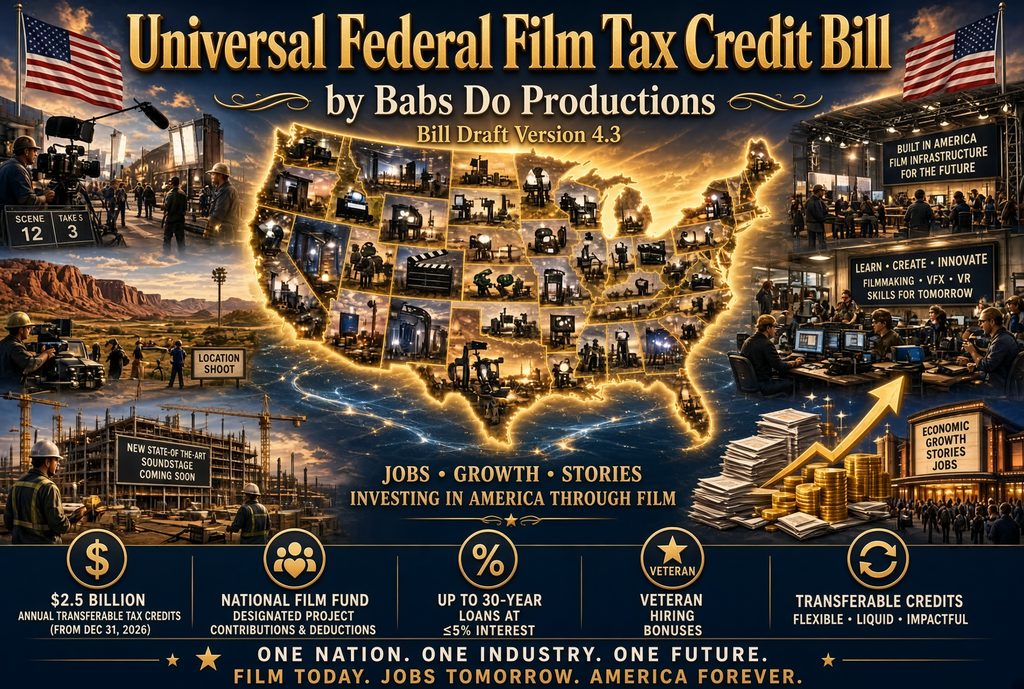
We have made a new version of our Universal Federal Film Tax Credit Bill for consideration now that talks are growing for the United States of America to adopt a Federal-based incentive program. This post will be our main point of reference to the latest draft of our Universal Federal Film Tax Credit Bill as we continue to update, refine, and innovate its legislation to provide the most comprehensive and beneficial Federal Film Tax Credit Bill in the United States of America! We at Babs Do Productions ask for your support as this movement moves forward in order to help every U.S. Artists, Student, and Worker in Film & Media across the country!
Major 4.3 Update – October 8 2026
After further review and consideration with new feedback, we refined things further and added some earlier draft elements back in to make Film & Media financing easier and restore some of the earlier benefits from previous drafts, this time in a much more structured way.
– We incorporated a small bit of crowdfunding support to provide a new offering for campaigns to secure significantly more investment opportunities than ever before for Film & Media projects! By combining campaigns with submissions to the National Film Fund, filmmakers can build up fan bases through crowdfunding campaigns and have direct incentive submissions to their project under the National Film Fund, whether it is to secure their overall project campaign goal or to direct fans to their project for Federal tax benefit (up to a certain limit), this would enable unheard of ease of investment and independent marketing for Film & Media projects than ever before!
– On the point of investment, we added new investment deduction caps of:
Production
- $1M per project with a maximum of $3M for Citizens
- $5M per project with a maximum of $15M for Companies
Can be divided across several projects. For example, Citizens can invest in 3 films at $1M each for $3M total or split smaller investment across 10 films with the same $3M maximum.
Infrastructure
- $5M maximum for Citizens per one big project or spread across any number of Infrastructure Projects
- $25M maximum for Companies per one big project or spread across any number of Infrastructure Projects
Citizens and Companies can invest in both categories for maximum benefit and focus on single projects or spread investment across multiple projects.
– Loan solutions through banks will be much easier for Film & Media projects to spur job creation through Production and Infrastructure with new regulations, education, and other solutions.
– Establish new rules for Investors and National Film Fund account management to support streamlined investment by multiple Investors, including coordination with State Film Offices and State Film Tax Credit Programs to help Investors to find approved projects. Keeps Film & Media investment safe, trackable, and secure in a whole new way for both Producers and Investors!
– We also added some language to make Infrastructure Development easier for smaller projects that may not need the $1M Minimum Spend, such as smaller studio and theater developments and more with a new $250,000 Minimum Spend.
Altogether, this update, along with added language for additional security and protections, provides more than enough updates for a more refined Version 4.3 that continues to provide the most advanced Federal Film Tax Credit legislation to benefit all U.S. Artists, Students, and Workers in Film & Media across the country!
Additionally, we did incorporate some of these new updates in our optional Support Act, now Version 1.1, as best as we could. However, these changes in the Universal Federal Film Tax Credit Bill Version 4.3 make it a far more preferable solution with its much greater systematic offerings. Rather than settling for Senator Schiff’s Production Tax Credit proposal and having to work in the Support Act to fix it, with this Version 4.3 update, Members of Congress should really focus on our Universal Federal Film Tax Credit Bill which presents a nearly flawless full-featured solution for the U.S. Entertainment Industry that would serve the country far better than any other proposal.
Companion Bill Option
To grant an option for a bill that isn’t a competing program to the current Federal Film Tax Credit Proposal, we drafted the “Federal Film & Media Infrastructure Support Act”. This companion bill takes the Infrastructure Tax Credit aspects and the innovations and solutions for simplifying and streamlining Film & Media financing so that the key benefits can be included no matter what the final Federal Film Tax Credit Bill legislation looks like. That will be posted below for consideration after the latest draft of our Universal Federal Film Tax Credit Bill. Now Version 1.1!
Bill Draft Version 4.3
A BILL
To enact the Universal Federal Film Tax Credit Program to provide accessible tax credits and loan assistance for film and media production and infrastructure development for all entities on a nationwide scale, foster local workforce training, and create a National Film Fund to sustain the program.
Be it enacted by the Senate and House of Representatives of the United States of America in Congress assembled,
SECTION 1. SHORT TITLE.
This Act may be cited as the Universal Federal Film Tax Credit Bill.
SECTION 2. FINDINGS AND PURPOSE.
(a) Findings. The Congress finds that:
(1) The film and media industry is a critical economic driver, contributing billions annually to the U.S. economy and supporting millions of jobs.
(2) Global competition from international film incentive programs threatens domestic production, reducing opportunities.
(3) Next-generation and as yet unknown media formats require flexible frameworks to drive innovation.
(4) Accessible financing, tax credits, streamlined incentives, stable labor agreements, and a dedicated National Film Fund for investments and designated project contributions are essential to spur immediate wide-scale economic activity and its continuous generation through film and media development across the United States.
(5) Establishing local workforce training equips American workers for high-wage careers in film, television, and digital media production.
(6) A federal program combining tax credits, financing incentives, asset retention, protections for production stability, and a National Film Fund can stimulate investment, boost economic activity, and maintain U.S. leadership in the global entertainment industry.
(b) Purpose. The purpose of this Act is to:
(1) Authorize an annual allocation of $2,500,000,000 in transferable tax credits beginning December 31, 2026, to support nationwide film and media production and infrastructure development.
(2) Provide ongoing support through the National Film Fund, including designated project contributions, loan guarantees, and workforce training.
(3) Facilitate production and infrastructure financing by certifying tax credits for use as collateral and guaranteeing privately originated loans.
(4) Offer production incentives to complement state film tax credit programs or serve as a standalone solution, with exemptions for states without programs.
(5) Establish the Office of Film and Media Industry within the Department of Commerce to administer the program and coordinate with state economic development departments.
(6) Allow redirection of funds for catastrophic emergencies.
(7) Establish a National Film Fund to provide supplementary support, designated project contributions, loan-guarantee backing, and workforce training.
(8) Promote economic growth in the film and media industry for all entities across the United States.
(9) Allow an individual a limited deduction for cash paid into an approved U.S. production or infrastructure project through the National Film Fund.
(10) Allow a U.S. business a limited deduction for cash paid into an approved U.S. production or infrastructure project through the National Film Fund.
SECTION 3. DEFINITIONS.
Unless the context otherwise requires:
(a) Capital Investment means costs incurred for the acquisition, construction, expansion, installation, equipping, upgrading, maintenance, or renovation of facilities, buildings, structures, or other infrastructure in the United States primarily for the production, distribution, or exhibition of qualified productions, financed by loans, grants, or other financial assistance, but excluding marketing, distribution, or financing fees.
(b) Office means the Office of Film and Media Industry within the U.S. Department of Commerce.
(c) Qualified Infrastructure Project means a project undertaken by a business or group of businesses in the United States involving the construction, expansion, improvement, equipping, upgrading, maintenance, or renovation of facilities primarily for:
(1) Production of qualified productions (e.g., film studios, soundstages, backlots, post-production facilities).
(2) Distribution of qualified productions (e.g., distribution centers, archives, warehouses, U.S.-based digital streaming platforms).
(3) Exhibition of qualified productions (e.g., movie theaters, film festival venues, broadcast facilities, screening rooms).
(4) Smaller entertainment-related projects (e.g., new production companies, film festivals).
A qualified infrastructure project shall be owned by a private applicant. Ownership by a Federal, State, or local government, or by a public authority, does not qualify.
(d) Qualified Production means a theatrical, direct-to-video, television, or digital media project, including videogame development and AI media production, produced for commercial distribution through theaters, television, video on demand, digital platforms, or similar channels, excluding:
(1) News, sports, weather, or current events programs.
(2) Productions for industrial, corporate, or institutional purposes.
(3) Productions with obscene material or requiring records under 18 U.S.C. § 2257.
(4) Productions solely for social media distribution.
(e) Qualified Direct Production Expenditures means expenditures in the United States for purchases, rentals, leases, or services from U.S. businesses during production, including set construction, wardrobe, photography, sound, lighting, filming, editing, post-production, payroll for U.S. residents, and state/local taxes, as specified in Section 9.
(f) Qualified Film Fund Investment. A contribution to the National Film Fund for funding qualified productions, as defined in Section 18(c).
(g) U.S. Business means a business entity organized under the laws of the United States or any State thereof that has its principal place of business in the United States and, with respect to any expenditure claimed as a Qualified Direct Production Expenditure or Capital Investment under this Act, employs or contracts with U.S. resident individuals (U.S. citizens or lawful permanent residents) as the primary workforce performing the services or work for which the expenditure is claimed.
SECTION 4. ESTABLISHMENT OF THE OFFICE OF FILM AND MEDIA INDUSTRY.
(a) Creation. The Office of Film and Media Industry is established within the U.S. Department of Commerce, headed by a Director appointed by the Secretary of Commerce.
(b) Duties. The Office shall:
(1) Administer the Universal Federal Film Tax Credit Program beginning December 31, 2026.
(2) Review and approve applications for infrastructure and noninfrastructure transferable tax credits, in coordination with state economic development departments.
(3) Facilitate loan guarantees and certify tax credits for use as collateral, as specified in Section 13.
(4) Coordinate with State and local governments to expedite review of approved infrastructure projects, as specified in Section 5(c).
(5) Administer the National Film and Media Workforce Training Fund, as specified in Section 10.
(6) Verify union status declarations and compliance for productions, as specified in Section 11.
(7) Submit annual reports to Congress on program outcomes, as specified in Section 14.
(8) Authorize redirection of funds for emergency use, as specified in Section 8(c).
(9) Administer the National Film Fund, including designated project contributions, as specified in Section 18.
(10) Provide training and advisory services to banks on evaluating film and media projects, reducing perceived risk for loans with limited collateral or credit profiles.
(c) Budget and Staffing. The Department of Commerce shall determine the Office’s budget and staffing, ensuring capacity to coordinate with State economic development departments, State film commissions, the Internal Revenue Service, and federal banking regulators.
(d) State Coordination. The Office shall:
(1) Require state economic development departments to evaluate and approve project applications before submission to the Office for tax credits or loan assistance.
(2) Collaborate with state film commissions to align federal and state incentives, ensuring the program complements existing state programs or serves as a standalone solution where none exist.
(e) Purpose. This section establishes the administrative framework to implement the program efficiently and in coordination with state partners.
SECTION 5. APPROVAL CRITERIA
(a) Approval Criteria. The Office shall approve applications for federal incentives for infrastructure projects and productions if:
(1) The state economic development department evaluates and approves the project or production for federal submission.
(2) The applicant submits a viable financing plan. The plan may include equity, loans, state incentives, National Film Fund support, and the federal tax credit reserved under this Act. The Office may grant a conditional reservation of tax credits based on that plan. A conditional reservation may be cited to lenders as intended collateral under Section 13. Final credit issuance remains subject to the audit and compliance requirements of this Act. A conditional reservation remains valid for 12 months and may be extended once, for up to 6 months, if the applicant shows an active financing campaign and a production or construction start date. The reservation expires if the project has not commenced within that period, and any unused reserved credit returns to the annual allocation.
(3) For infrastructure projects, the minimum capital investment incurred in the United States is:
(A) $1,000,000 for a production facility, including a film studio, soundstage, or backlot; and
(B) $250,000 for an exhibition, post-production, distribution, or other qualified infrastructure project under Section 3(c), including a movie theater, screening room, post-production office, dub stage, archive, or similar facility.
(4) For productions, the minimum federal production spend requirements ($500,000 in states with film tax credit programs, $150,000 in states without) are met.
(5) Within 365 days of construction, expansion, upgrade, maintenance, or production completion (extendable by 180 days), an audit by an independent U.S.-based certified public accountant, approved by the Office, itemizes expenditures and confirms compliance, including union status declarations, U.S. resident labor compliance, and vendor nationality/residency breakdowns for animation, VFX, and digital services as specified in Sections 9, 11, and 12.
(6) The applicant pays the audit cost.
(7) The applicant provides tax compliance notices to contractors and vendors, as specified in subsection (d).
(b) Additional Funding Provision. If unallocated credits remain available under the annual allocation in Section 8, infrastructure project applicants may request additional credit support from the Office to cover unforeseen cost overruns, higher-quality infrastructure, or expansion that will enhance the program’s national impact, subject to the project cap in subsection (e), availability, and coordination with State economic development departments.
(c) Zoning Coordination. The Office shall coordinate with State and local governments to expedite review of approved infrastructure projects after completion of required land surveys and due diligence. Nothing in this Act preempts local zoning, land-use, environmental, or safety authority. States and localities are encouraged to establish expedited review procedures for projects approved under this Act.
(d) Application Requirements. Applications must include:
(1) For infrastructure: A detailed plan or blueprint of the project.
(2) For productions: A script, storyboard, or synopsis, and a declaration of union, non-union, or mixed union status with documented consent for non-union or mixed union productions, as specified in Section 11.
(3) Names of the developer/producer and key personnel/contractors.
(4) Estimated timeline and budget, including non-U.S. expenditures.
(5) Financing details (e.g., loan commitments, investment letters).
(6) Acknowledgment that application materials are public records unless confidentiality is approved by the Office.
(7) Proof of general liability insurance (minimum $2,000,000).
(8) Proof of compliance with workers’ compensation and U.S. business licensing requirements.
(9) A tax compliance notice for contractors/vendors, stating federal tax obligations and directing to IRS resources.
(e) Project Cap. Credits for a single infrastructure project shall not exceed $85,000,000 per fiscal year, and for a single production shall not exceed $50,000,000 per fiscal year.
(f) Allocation. The Office shall ensure distribution of credits to support infrastructure and production projects in all states with infrastructure projects taking priority during the first phase.
(g) Exceptions.
(1) An applicant is not eligible for infrastructure tax credits under this Act if:
(A) the applicant is not a United States person, or is not organized and taxable in the United States; or
(B) the project would construct, expand, service, upgrade, or maintain infrastructure located outside the United States.
(2) Infrastructure credits under this Act shall not be used to construct, expand, service, upgrade, or maintain any infrastructure located outside the United States.
(3) A U.S. or foreign service provider that offers financing or management services for film and media facilities may apply on behalf of an eligible U.S. owner if the service provider submits proof that it has no direct or indirect ownership of the project and that the credits will not be used for infrastructure outside the United States.
(4) Ownership or use of foreign production facilities does not, by itself, disqualify an otherwise eligible U.S. applicant from receiving credits for a qualified infrastructure project located in the United States.
(5) A Federal, State, or local government, or any agency, instrumentality, or public authority thereof, is not eligible to apply for, receive, or own tax credits or infrastructure under this Act. Nothing in this paragraph prevents such a government from reviewing, approving, or coordinating a private application, or from issuing permits for a project owned by an eligible private applicant.
(h) Approval Integrity.
(1) The Office shall verify the identity of each principal, and that the applicant is a U.S. Business in good standing, before issuing a conditional reservation or opening a Fund account.
(2) Designated contributions shall be held by the Fund and shall not be released until the project has commenced and the Office has confirmed a start of principal photography or construction. If the project does not commence within the reservation period, contributions shall be returned. If, after release, an audit finds that contributed funds were used for a nonqualified purpose or were obtained by a material false statement, the Office shall require repayment of the misused amount to the Fund and shall apply the bar in paragraph (4).
(3) A related-party payment qualifies only at fair market value, as documented in the audit. Amounts paid to a principal, or to an entity controlled by a principal, for services not actually performed do not qualify. A contribution returned, directly or indirectly, to the contributor or to an entity controlled by the contributor is not deductible, and the related expenditure is not qualified, unless the audit shows services or goods were actually provided at fair market value.
(4) An applicant, principal, or project that submits a material false statement is ineligible for credits, guarantees, and Fund contributions for 5 years. A second material false statement is a permanent bar. A principal who directed the misuse remains personally liable for the repaid amount if the applicant entity does not pay. The Office shall refer apparent fraud to the appropriate law-enforcement authority. This Act does not create a new criminal offense.
(5) The Office may refuse or revoke a reservation, and close a Fund account, if the application appears intended to raise funds without a bona fide production or construction plan.
(6) The Office shall not certify a project for investor notice under Section 18(c)(7) until the identity check and the conditional reservation are complete.
SECTION 6. INFRASTRUCTURE TRANSFERABLE TAX CREDITS.
(a) Eligibility. U.S.-based Infrastructure developers undertaking qualified infrastructure projects in the United States may apply for transferable tax credits using credits allocated under Section 8 and, as available, support from the National Film Fund under Section 18, beginning December 31, 2026. Qualified infrastructure projects include those supporting the production, distribution, or exhibition of film, media, and interactive media projects, as defined in Section 3(c).
(b) Approval Criteria and Application Requirements. The Office shall approve applications for infrastructure tax credits if the criteria and requirements specified in Section 5(a) (Approval Criteria) and Section 5(d) (Application Requirements) are met. The minimum capital investment requirement in Section 5(a)(3) applies at all times.
(c) Credit Calculation and Project Cap. Tax credits shall be calculated as specified in Section 12, with a cap of $85,000,000 per fiscal year for a single infrastructure project.
(d) Allocation. The Office shall ensure distribution of credits to support U.S.-based infrastructure projects in all states, in coordination with state economic development departments.
SECTION 7. NONINFRASTRUCTURE TRANSFERABLE TAX CREDITS
(a) Eligibility. Production companies producing qualified productions in the United States may apply for noninfrastructure transferable tax credits, complementing state film tax credit programs or serving as a standalone solution. Credits shall be funded using credits allocated under Section 8 and, as available, support from the National Film Fund under Section 18, beginning December 31, 2026. Qualified productions include film, media, and interactive media projects, as defined in Section 3(d).
(b) Approval Criteria. The Office shall approve applications if:
(1) The state economic development department evaluates and approves the production for federal submission, per Section 4(d)(1).
(2) The applicant submits a viable financing plan. The plan may include equity, loans, state incentives, National Film Fund support, and the federal tax credit reserved under this Act. The Office may grant a conditional reservation of tax credits based on that plan. A conditional reservation may be cited to lenders as intended collateral under Section 13. Final credit issuance remains subject to the audit and compliance requirements of this Act. A conditional reservation remains valid for 12 months and may be extended once, for up to 6 months, if the applicant shows an active financing campaign and a production or construction start date. The reservation expires if the project has not commenced within that period, and any unused reserved credit returns to the annual allocation.
(3) At least 90 percent of principal photography days occur in the United States. For animated productions and projects in which the majority of work consists of digital creation rather than traditional principal photography, the 90 percent requirement shall be applied to the production budget or work volume attributable to creative and technical labor performed in the United States or by U.S. resident individuals. The production shall also meet the minimum federal production spend requirement of $500,000 in States with film tax credit programs, or $150,000 in States without such programs.
(4) Within 365 days of principal photography or post-production completion (extendable by 180 days), an audit by an approved U.S.-based certified public accountant itemizes expenditures and confirms compliance, including union status declarations, U.S. resident labor compliance, and vendor nationality/residency breakdowns for animation, VFX, and digital services as specified in Sections 9, 11, and 12.
(5) The applicant pays the audit cost.
(6) The production includes an on-screen acknowledgment of the United States, unless prohibited by law or if not distributed.
(7) Tax compliance notices are provided to contractors/vendors, as specified in subsection (e)(9).
(c) Union Status Declaration. All productions must comply with union status declaration requirements as specified in Section 11.
(d) Credit Calculation. The base credit shall be calculated as specified in Section 12, with a cap of $50,000,000 per fiscal year for a single production.
(e) Application Requirements. Applications must include:
(1) A script, storyboard, or synopsis.
(2) Names of the producer and key personnel/contractors.
(3) Estimated timeline and budget, including non-U.S. expenditures.
(4) Financing details (e.g., loan commitments, investment letters).
(5) A declaration of union, non-union, or mixed union status with documented consent for non-union or mixed union productions, as specified in Section 11.
(6) Acknowledgment that application materials are public records unless confidentiality is approved by the Office.
(7) Proof of general liability insurance (minimum $2,000,000).
(8) Proof of compliance with workers’ compensation and U.S. business licensing requirements.
(9) A tax compliance notice for contractors/vendors, stating federal tax obligations and directing to IRS resources.
(f) Exception. Non-U.S. productions incurring at least $500,000 in U.S.-based post-production services may qualify for credits, with a cap of $8,000,000 per fiscal year, subject to the approval criteria in subsection (b) and union status requirements in Section 11.
(g) Allocation. The Office shall ensure distribution of credits to support production projects in all states, in coordination with state economic development departments.
SECTION 8. FUNDING, CARRYOVER, AND EMERGENCY USE.
(a) Credit Allocation.
(1) For each fiscal year beginning December 31, 2026, the Office may allocate not more than $2,500,000,000 in transferable tax credits under this Act.
(2) Credits shall support:
(i) Infrastructure projects as specified in Sections 5 and 6.
(ii) Qualified productions as specified in Section 7.
(iii) Additional film and media infrastructure and innovation projects determined by the Office to advance the purposes of this Act.
(3) There are authorized to be appropriated such sums as may be necessary for administration of the Office and for a loan-guarantee reserve under Section 13. Such sums are separate from the credit allocation in paragraph (1) and shall not be used as a general infrastructure construction pot. For each fiscal year beginning December 31, 2026, there is authorized to be appropriated $500,000,000 for the loan-guarantee reserve. Total guarantees outstanding shall not exceed 5 times the funded reserve.
(b) Carryover. Up to 50 percent of unallocated credits may be carried forward to the next fiscal year, prioritized for States with active infrastructure or production projects.
(c) Emergency Use. Amounts available under this Act, including amounts in the National Film Fund, may be redirected only for catastrophic emergencies or disasters that damage or halt film and media infrastructure or productions, as determined by the Office in coordination with State economic development departments and subject to approval by the Secretary of Commerce. Funds may not be redirected for unrelated State projects.
(d) National Film Fund. The National Film Fund under Section 18 shall provide supplementary support, loan-guarantee backing, designated project contributions, and workforce-related transfers, consistent with the annual credit allocation in subsection (a).
SECTION 9. QUALIFIED EXPENDITURES.
(a) Eligible Expenditures. Qualified direct production expenditures and capital investments include:
(1) Set construction, wardrobe, photography, sound, lighting, filming, editing, and post-production services.
(1.1) Special Rule for Animation, Visual Effects, and Digital Creative Services. For animation (including character animation, modeling, rigging, texturing, lighting, and rendering), visual effects, compositing, digital asset creation, and related post-production or creative digital services, expenditures qualify as Qualified Direct Production Expenditures only if:
(A) the services are performed in the United States; and
(B) the services are performed by U.S. resident individuals or by U.S. Businesses, as defined in Section 3(g), where the primary workforce performing the services consists of U.S. resident individuals.
Expenditures paid to foreign entities or for work performed predominantly by non-U.S. resident individuals do not qualify, regardless of the location of payment or any intermediary.
(2) Development, production, or integration of interactive media content, including virtual reality (VR), augmented reality (AR), and other innovative media formats.
(3) Acquisition, subscription, rental, or leasing of facilities, equipment, and vehicles, where equipment includes software used for production, editing, or interactive media development (e.g., editing suites, VR/AR tools).
(4) Payroll for U.S. residents, including wages, salaries, fringe benefits, and per diem.
(5) State and local taxes not included elsewhere.
(6) Design, construction, expansion, improvement, upgrading, maintenance, or renovation of infrastructure for production, distribution, or exhibition, including facilities supporting film, media, and interactive media projects.
(7) Costs for smaller entertainment projects (e.g., film festivals, new production companies).
(8) Other transactions authorized by Office of Film and Media Industry regulations, as specified in Section 16(a)(8).
(b) Ineligible Expenditures. Exclusions include:
(1) Costs for tax credit acquisition, marketing, financing, depreciation, amortization, or audits.
(2) Reimbursed or expected-to-be-reimbursed costs.
(3) Affiliate payments unless at fair market value.
(4) Costs previously claimed under this or other federal/state programs.
(c) Special Rule.
(1) Tangible personal property acquired by a U.S. business from a foreign vendor for resale or lease to an applicant is deductible if the business regularly deals in such property.
(2) Direct purchases of specialty equipment (e.g., lenses, motion control robots, lighting gear) from foreign vendors are deductible if the equipment is unavailable or impractical to source through U.S. businesses due to scheduling, costs, or other factors, subject to approval by the Office of Film and Media Industry. Applicants must provide documentation verifying the equipment’s use in qualified productions or infrastructure projects, U.S.-based transaction payments, and lack of immediate U.S. alternatives. The Office shall verify compliance through audits, with criteria established via regulations under Section 16.
SECTION 10. NATIONAL FILM AND MEDIA WORKFORCE TRAINING FUND.
(a) Creation. The National Film and Media Workforce Training Fund is established in the Treasury, administered by the Office of Film and Media Industry which shall supervise workforce training programs.
(b) Funding Sources. The Fund consists of:
(1) 1.5 percent fees from issued infrastructure and noninfrastructure transferable tax credits, as specified in Sections 5, 6, and 7.
(2) 1 percent fee from guaranteed loan amounts, as specified in Section 13.
(3) Grants, gifts, donations, or appropriations.
(4) Interest earned on fund balances.
(c) Use. Funds shall be distributed as grants to:
(1) Accredited U.S. colleges, universities, state or local governments, school districts, charter schools, nonprofit organizations, labor unions, or private vocational schools for workforce training in qualified productions, including skills for film, media, and interactive media projects, such as virtual reality (VR), augmented reality (AR), and other innovative media formats known or not yet known.
(2) Programs offering workshops on basic filmmaking, working on set, industry practices, stunt work, equipment training, and other skills to prepare workers for professional productions, in collaboration with local schools, film programs, and entertainment unions where available. Workshops may use studio spaces or designated training areas for instruction and equipment testing, with hired instructors and volunteer entertainment stakeholders where feasible.
(d) Emergency Use. Up to 75 percent of unallocated funds may be redirected for emergency purposes (e.g., catastrophic events impacting film and media infrastructure or productions), subject to approval by the Secretary of Commerce and coordination with state economic development departments, as reported per Section 14(a)(6).
(e) Excess Funds. Funds exceeding workforce training needs, as determined by the Office after grant allocations, may be redirected to support the Universal Federal Film Tax Credit Program (e.g., credits under Sections 5, 6, or 7), capped at 25 percent of annual fund balances, subject to Office approval and reporting per Section 14(a)(6).
(f) Board. A National Film and Media Workforce Training Board is created within the Office which may designate representatives to supervise board activities. The board’s composition and terms shall be determined by the Secretary of Commerce, including representatives from:
(1) Film and media industry organizations (e.g., Motion Picture Association).
(2) Educational institutions.
(3) State economic development departments.
(4) Labor organizations.
(g) Board Duties. The Board shall:
(1) Establish grant application procedures and approval criteria, prioritizing nationwide access and collaboration with union training programs where available.
(2) Require recipients to implement workforce development strategies with measurable outcomes, including job placement in professional productions.
(3) Approve grants by majority vote, ensuring equitable distribution across states.
(4) Provide a 5 percent bonus on training grants for programs hiring U.S. veterans in instructional or administrative roles, per regulations under Section 16.
(h) Non-Reversion. Funds do not revert to the Treasury General Fund at fiscal year-end.
(i) Purpose. This section fosters a skilled U.S. workforce for the film and media industry, supports emergency needs, and enhances the tax credit program’s sustainability.
SECTION 11. UNION STATUS DECLARATION FOR PRODUCTIONS.
(a) Declaration Requirement. All productions applying for tax credits under the Universal Federal Film Tax Credit Program must declare their union, non-union, or mixed union status before production commences.
(b) Consent Requirements. Documented consent for non-union or mixed union productions shall consist of written, signed agreements from all crew members, performers, and staff, obtained prior to production, confirming their understanding and acceptance of the declared union status. Such agreements must comply with federal and state labor laws, including the National Labor Relations Act, and be retained for audit verification. The Office of Film and Media Industry shall provide a standardized consent template via regulations under Section 16.
(c) Labor Stability. A production that has made a timely declaration and obtained required consent shall not lose tax credits solely because of the declared union, non-union, or mixed status, provided the declaration and consent comply with the National Labor Relations Act and other applicable labor laws. Nothing in this section limits the rights of employees to organize or the application of federal or State labor law after production begins. Status changes remain subject to subsection (d).
(d) Status Changes. Productions changing union status mid-production must notify the Office within 30 days, providing documentation justifying the change. The Office may approve the change without loss of tax credits if it determines the change was necessary to comply with labor laws, maintain production stability, or enhance economic impact, subject to audit verification and regulations under Section 16. If the change occurs between program years, the production may lose tax credit issuance for the initial year and receive credits only for the subsequent year, subject to re-approval.
(e) Penalties. Violations of union status requirements shall be penalized as follows, per regulations under Section 16:
(1) Minor violations (e.g., clerical errors): Corrective action and warning.
(2) Moderate violations (e.g., unintentional non-compliance): Temporary suspension or reduced credits.
(3) Severe violations (e.g., deliberate false reporting, labor law violations): Removal or banning from the program. Parent company liability applies only if directly complicit, as determined by the Office.
(f) Verification and Disputes. The Office shall verify union status declarations during audits, as specified in Sections 5(a)(5), 7(b)(4), and 12. The Office shall establish, via regulations under Section 16, a mediation or arbitration process to resolve union status disputes promptly, minimizing disruption to production schedules and tax credit issuance. Disputes shall be reported in the annual report under Section 14(a)(6).
(g) Purpose. This provision protects production budgets and schedules, expedites tax credit disbursement, and balances union and non-union participation to foster economic growth.
SECTION 12. TAX CREDIT CALCULATIONS.
(a) Base Credit Calculation. For projects and productions eligible for tax credits under this Act, the base credit shall be calculated as follows:
(1) Infrastructure Projects. 35 percent of qualified capital investments, as defined in Section 9, incurred in the United States during the first fiscal year beginning December 31, 2026, and 30 percent in each fiscal year thereafter.
(2) Productions. 25 percent of qualified direct production expenditures, as defined in Section 9, for film, media, and interactive media projects produced primarily in the United States.
(b) Conditions.
(1) U.S.-Based Production. Productions with international sequences or digital/creative work (including animation, visual effects, compositing, modeling, rigging, or other digital asset creation) exceeding 5 percent, as measured by filming days, budget allocation, work volume, or other criteria established by the Office via regulations under Section 16, require case-by-case approval. Approval criteria shall include U.S. job creation, with particular emphasis on animation, VFX, and creative labor, net economic return to the United States, and compliance with program goals, as verified by audits.
(2) Foreign Production Companies. Foreign companies qualify if at least 90 percent of production days and expenditures occur in the United States, verified by audits requiring detailed expenditure breakdowns and U.S. residency checks, per regulations under Section 16. Applicants must submit pre-production U.S. expenditure plans to the Office.
(3) Withholding. Credits may be withheld, in whole or in part, for:
(i) Damages to State or local governments.
(ii) Legal violations, including labor-law or tax non-compliance.
(iii) False statements, including fraudulent expenditure claims.
Withholding shall be tiered: partial for minor issues, full for severe issues, with appeal rights per regulations under Section 16. Violations shall be reported per Section 14.
(4) Veteran Hiring Bonus. An additional 5 percent credit for a qualified production or qualified infrastructure project that hires U.S. veterans in at least 5 percent of crew, cast, or construction roles, as verified by audits and per regulations under Section 16.
(5) U.S. Labor and Domestic Content Requirement. To receive the full base credit under subsection (a), a production must certify, and the Office must verify through audit, that at least 75 percent of Qualified Direct Production Expenditures attributable to artistic, creative, technical, and production labor — including animation, visual effects, compositing, character design, storyboarding, editing, sound design, and related digital work — are paid to or for the benefit of U.S. resident individuals or U.S. Businesses employing such individuals as the primary workforce. The Office may proportionally reduce the allowable credit or require case-by-case approval, with heightened scrutiny on net U.S. job creation, for productions below this threshold. This requirement applies in addition to Section 7(b)(3) and subsection (b)(1) of this section.
(c) Production Cost Deductions. In addition to tax credits, qualified productions may elect to expense 100 percent of U.S. production costs in the year incurred, up to $40,000,000 per project, as administered by the IRS under regulations per Section 16. This deduction is available for feature films, TV series, pilots, and movies, excluding those ineligible under Section 3(d)(3).
(d) Verification. The Office shall verify compliance through audits, as specified in Sections 5(a)(5), 7(b)(4), and 9, including U.S. resident labor compliance and vendor residency breakdowns for animation, VFX, and digital services. Criteria shall be defined in regulations under Section 16, to be issued within 120 days of enactment.
(e) Purpose. This section ensures tax credits incentivize U.S.-based economic activity and U.S. artists while maintaining program integrity.
SECTION 13. LOAN ASSISTANCE AND GUARANTEE PROGRAM FOR FILM AND MEDIA FINANCING.
(a) Authority. The Office is authorized to facilitate loan assistance for infrastructure developers and production companies approved for tax credits under Sections 5, 6, or 7 by:
(1) certifying approved tax-credit amounts for use as collateral; and
(2) issuing or arranging federal guarantees of privately originated loans, subject to availability of the guarantee reserve authorized in Section 8(a)(3).
The Office shall not originate or service loans as a direct federal lender.
(b) Loan Terms. A loan eligible for assistance or guarantee under this section may:
(1) have a term of up to 30 years;
(2) bear a fixed interest rate of not more than 5 percent per annum, with total interest not exceeding 50 percent of principal;
(3) remain fully enforceable to the maximum extent permitted under title 11, United States Code; and
(4) include commercially reasonable default remedies consistent with federal consumer-protection and usury limits.
(c) Eligibility. Applicants must:
(1) receive approval for tax credits under Sections 5, 6, or 7;
(2) demonstrate significant U.S. economic benefit, including examples such as creation of 50 U.S. jobs (full-time, part-time, or indirect) or 80 percent U.S. expenditures, per regulations under Section 16;
(3) provide a budget and repayment or revenue plan; and
(4) submit to audits verifying loan use, expenditures, and economic impact.
(d) Private Lending. U.S. insured depository institutions may originate the loans, using certified tax credits as collateral and any Office guarantee as credit support. Lenders shall comply with federal banking, anti-money-laundering, and consumer-protection requirements. A government entity shall not originate, hold, or own the loan, the project, or the tax credit. A State or local government may provide ordinary permits, zoning review, or information to a private lender and a private applicant.
(e) Regulatory Coordination. The Office shall coordinate with the Board of Governors of the Federal Reserve System, the FDIC, and the OCC to issue collateral and guarantee guidelines within 120 days of enactment.
(f) Reporting. The Office shall report annually, per Section 14, on the number and value of guarantees and assisted loans, repayment and default experience, and economic impact.
(g) Purpose. This section simplifies Film and Media financing by making approved tax credits usable as collateral and by guaranteeing private loans, without creating a new federal lending bank.
(h) A 1 percent fee on guaranteed loan amounts shall be transferred to the National Film and Media Workforce Training Fund under Section 10.
(i) Conditional Reservation.
(1) Within 45 days after a complete application, the Office shall issue a conditional reservation stating the estimated credit, the maximum guarantee, and the conditions for final certification.
(2) A lender may rely on that reservation as a conditional commitment, subject to final audit. The guarantee becomes effective upon audit certification, or upon certification that the stated share of principal photography or construction has been completed.
(3) For a qualified production, the guarantee shall cover not more than 80 percent of outstanding principal and not more than the certified credit amount. For a qualified infrastructure project, the guarantee shall cover not more than 80 percent of outstanding principal and not more than 150 percent of the certified credit amount, subject to the guarantee reserve.
(4) Final credit issuance and guarantee effectiveness remain subject to the audit and compliance requirements of this Act.
SECTION 14. REPORTING AND OVERSIGHT.
(a) Annual Report. By November 30 each year, beginning in 2027, the Office of Film and Media Industry shall submit a report to Congress and the Office of Management and Budget, and post it on the Office’s public website within 30 days, detailing for the prior fiscal year:
(1) Number of applications and approvals by state for tax credits and loan assistance, per Sections 5, 6, and 7.
(2) Credit and loan assistance amounts approved, used, and transferred, per Sections 12 and 13.
(3) Total qualified expenditures and capital investments, with U.S. allocations, per Section 9.
(4) Employment data, including U.S.-resident jobs (full time, part time, indirect) and wages, per Sections 5, 6, and 7.
(5) Economic impact analysis by state and region, including GDP contribution, tax revenue, and indirect jobs, per regulations under Section 16.
(6) Instances of emergency fund redirection (Section 8(c)), loan assistance outcomes (Section 13(f)), union status disputes (Section 11(f)), disruptions and relief granted (Section 15(e)), violations (e.g., false statements, labor violations, Section 12(b)(3)), and with details on penalties, resolutions, and repayments.
(b) State Coordination. The Office shall collaborate with state economic development departments and film commissions for data collection and compliance verification, per Sections 4(d) and 5(a)(1).
(c) Purpose. This section ensures transparency, accountability, and evaluation of the program’s economic impact across the United States.
SECTION 15. DISRUPTION MANAGEMENT.
(a) Purpose. This section establishes procedures to manage interruptions, cancellations, or other disruptions to qualified infrastructure projects or productions, ensuring program stability and economic continuity across the United States.
(b) Covered Disruptions. Disruptions include, but are not limited to, labor strikes, natural disasters, government-mandated closures, supply chain failures, pandemics or other worldwide emergencies, or other force majeure events, as defined by regulations under Section 16.
(c) Relief Procedures. Applicants facing disruptions may request relief from the Office of Film and Media Industry, including:
(1) Extension of tax credit application or audit deadlines by up to 180 days, per Sections 5(a), 6(b), or 7(b)(4).
(2) Temporary union status adjustments without loss of tax credits, per Section 11(d), with documented justification (e.g., strike agreements).
(3) Loan repayment extensions or penalty waivers, per Section 13(b).
(4) Access to emergency funds for critical projects, per Section 8(c).
(d) Application Process. Applicants must notify the Office within 30 days of a disruption, providing documentation (e.g., union strike notices, closure orders, pandemic declarations). The Office shall review requests within 60 days, granting relief if the disruption significantly impairs project completion, per regulations under Section 16.
(e) Reporting. Approved relief, disruptions, and outcomes shall be reported annually, per Section 14(a)(6).
(f) Regulations. The Office shall issue guidelines within 120 days of enactment, per Section 16, defining disruption criteria, relief processes, and documentation requirements.
(g) Purpose. This section mitigates the impact of unforeseen disruptions, supporting the film and media industry’s economic contributions.
SECTION 16. REGULATIONS.
(a) Regulations. Within 120 days of enactment, the Office of Film and Media Industry, in consultation with the IRS, the Board of Governors of the Federal Reserve System, the FDIC, and the OCC, shall adopt regulations to:
(1) Prescribe application review processes for tax credits and loan assistance.
(2) Define any additional qualified expenditures, including interactive media formats and other related film and media expenditures and categories.
(3) Prohibit credits or assistance for productions requiring age verification records under 18 U.S.C. § 2257 (relating to sexually explicit content).
(4) Establish procedures for:
(i) Emergency fund redirection, per Section 8(c).
(ii) Loan assistance administration, including hardship reviews, per Section 13.
(iii) Union status declarations and compliance verification, including standardized consent templates, per Section 11(b).
(iv) Penalties for violations (e.g., false statements, labor violations), per Sections 11(e) and 12(b)(3).
(v) Disruption management criteria and relief processes, including for pandemics or other worldwide emergencies, per Section 15(f).
(vi) Other transactions eligible as qualified expenditures, per Section 9(a)(8).
(b) Stakeholder Input. The Office shall solicit input from industry stakeholders, including but not limited to production companies, infrastructure developers, labor unions, state film commissions, trade organizations, and educational institutions, during regulation development to ensure practical and effective implementation.
(c) Oversight. The IRS shall adopt regulations for credit administration and penalty enforcement. Banking regulators shall oversee loan assistance compliance.
(d) Purpose. This section ensures timely, clear, and compliant administration of the program.
SECTION 17. EFFECTIVE DATE AND SUNSET.
(a) Effective Date. This Act is effective December 31, 2026, unless delayed due to disruptions per Section 15(c)(1), as determined by the Office of Film and Media Industry.
(b) Sunset. This Act expires June 30, 2050, unless extended by a Congressional vote by June 30, 2050, based on economic impact analysis per Section 14(a)(5).
(c) Severability. If any provision of this Act is held invalid, the remaining provisions shall remain in effect to the fullest extent possible.
(d) Purpose. This section ensures a clear timeline for program implementation and longevity, supporting economic growth in the film and media industry while providing flexibility for disruptions and legal challenges.
SECTION 18. NATIONAL FILM FUND.
(a) Creation. The National Film Fund is established in the Treasury, administered by the Office, to provide supplementary funding for qualified infrastructure projects and productions.
(b) Funding Sources. The Fund consists of:
(1) Voluntary contributions from individuals and businesses;
(2) Grants, gifts, donations, or appropriations;
(3) Interest earned on Fund balances;
(4) Recoveries and repayments related to guarantees or Fund support;
(5) Fees transferred under this Act, including training-related fees as specified in Section 10; and
(6) Any other amounts authorized by law.
(c) Use. Amounts in the Fund shall be available for:
(1) Grants or other non-ownership support for qualified U.S. projects, with priority for U.S. job creation and workforce development;
(2) Support for the loan-guarantee reserve under Section 13;
(3) Workforce training transfers consistent with Section 10;
(4) Acceptance of designated contributions for a specific qualified project, with the Fund providing verification and tax reporting for the contributor and the production. The Fund shall not operate a securities offering platform or public crowdfunding exchange; and
(5) Administrative costs, not to exceed 5 percent of annual inflows.
(6) Multiple contributors. The Fund may accept designated contributions from more than one individual or entity for the same approved project, hold those amounts in one project account, and issue a separate tax statement to each contributor. The per-contributor limitations in subsections (j) and (k) apply to each contributor. No contributor is barred because another contributor has reached that contributor’s limitation. The project owner may raise the remainder from private sources without using the Fund.
(7) Project notice. The Office shall maintain a public list of projects approved under this Act that have an open Fund account and are accepting designated contributions. Where a State film office or State film commission exists, the Office shall coordinate the list with that office, including projects approved under a State film tax credit program. The list may state the project name, State, type, approval date, whether a State credit is attached, and whether the account is open. It shall not state a target return, rank projects, or solicit an investment. A project owner may ask that the listing be withheld. Publication of the list is not an offer or sale of a security, and the Office is not a broker or adviser.
(d) Tax Treatment of Contributions. Except as provided in subsections (j) and (k), contributions to the Fund may be deducted only to the extent otherwise allowed under the Internal Revenue Code of 1986. This Act does not create a new special deduction cap or a new class of write-off for general contributions to the Fund.
(e) Board. A National Film Fund Board is created within the Office. Composition shall be determined by the Secretary of Commerce and shall include representatives from film and media industry organizations, educational institutions, State economic development departments, and labor organizations.
(f) Board Duties. The Board shall:
(1) Establish application procedures and approval criteria for Fund support;
(2) Prioritize projects with measurable U.S. job creation and domestic production; and
(3) Approve major distributions by majority vote.
(g) Revolving Fund. The Fund shall operate as a revolving fund. Amounts returned to the Fund remain available without fiscal-year limitation and do not revert to the general fund.
(h) Reporting. Fund activity shall be included in the annual report under Section 14, including contributions, designated project support, guarantees backed, and economic impact.
(i) Purpose. This section provides a supplementary funding source for U.S. production and infrastructure without requiring government ownership of productions.
(j) Deduction for Designated Project Investment.
(1) In general. An individual who pays cash to the National Film Fund as a designated contribution for a specific qualified production or qualified infrastructure project approved under this Act may elect to deduct that cash in the taxable year in which it is paid.
(2) Dollar limitation. An individual may deduct up to $1,000,000 per approved qualified production and not more than $3,000,000 per taxable year for all such productions. The yearly amount may be allocated across more than one production, but no production may account for more than $1,000,000. An individual may deduct up to $5,000,000 per taxable year for qualified infrastructure projects, and the full amount may be allocated to one project. The infrastructure amount may also be allocated across more than one qualified infrastructure project. A taxpayer may claim both limitations in the same taxable year. The production limitation and the infrastructure limitation are calculated separately and may not be combined into a larger limitation for either category.
(3) At risk. The deduction is allowed only to the extent the individual is at risk within the meaning of section 465 of the Internal Revenue Code of 1986. A pledge, a promissory note, or borrowed funds for which the individual is not personally liable do not qualify.
(4) Qualified use. At least 75 percent of the designated contribution must be used for Qualified Direct Production Expenditures that meet Sections 9 and 12(b)(5), including U.S. resident labor. Amounts used for marketing, financing fees, or work performed outside the United States do not qualify. A contribution for a qualified infrastructure project must meet the same 75 percent test for Capital Investment under Sections 5(g) and 9.
(5) No double benefit. An amount deducted under this subsection shall not also be treated as a qualified expenditure for the production-cost expensing election under Section 12(c), and shall not increase the tax credit under Section 12. This deduction is not a tax credit and may not be transferred.
(6) Recapture. If the project fails the applicable audit, or fails the U.S.-labor or U.S.-location rules of this Act, the individual shall include the deducted amount in gross income in the taxable year of the failure, reduced by any amount already returned to the individual.
(7) Passive activity. Section 469 of the Internal Revenue Code of 1986 shall apply to this deduction unless the individual materially participates in the production.
(8) Reporting. The Fund shall issue the individual and the Internal Revenue Service a statement of the amount paid, the project, and the amount certified as qualifying.
(9) Platform referral. A crowdfunding platform may direct contributors to make a designated contribution to the National Film Fund for a production or infrastructure project approved under this Act. A contribution qualifies for the deduction under this subsection only if it is paid to the Fund and reported under paragraph (8). A payment held by the platform, or paid to the producer through the platform, does not qualify. The platform is not an agent of the Fund and has no authority to approve projects or issue tax statements.
(k) Deduction for Business Investment.
(1) In general. A business entity organized and taxable in the United States that pays cash to the National Film Fund as a designated contribution for a specific qualified production or qualified infrastructure project approved under this Act may elect to deduct that cash in the taxable year in which it is paid.
(2) Dollar limitation. An entity may deduct up to $5,000,000 per approved qualified production and not more than $15,000,000 per taxable year for all such productions. The yearly amount may be allocated across more than one production, but no production may account for more than $5,000,000. An entity may deduct up to $25,000,000 per taxable year for qualified infrastructure projects, and the full amount may be allocated to one project. An entity may claim both limitations in the same taxable year. The production limitation and the infrastructure limitation are calculated separately and may not be combined into a larger limitation for either category. The infrastructure amount may also be allocated across more than one qualified infrastructure project.
(3) Qualified use. At least 75 percent of the contribution must fund Qualified Direct Production Expenditures or Capital Investment that meet Sections 5(g), 9, and 12. Amounts used outside the United States, or for marketing or financing fees, do not qualify.
(4) No double benefit. An amount deducted under this subsection shall not also be claimed under Section 12(c) or Section 18(j), and shall not increase the tax credit under Section 12.
(5) Recapture. If the project fails the applicable audit or the U.S.-labor or U.S.-location rules of this Act, the entity shall include the deducted amount in gross income for the taxable year of the failure, reduced by any amount returned.
(6) Reporting. The Fund shall report the amount paid, the project, and the qualifying amount to the entity and the Internal Revenue Service.
(7) Platform referral. A crowdfunding platform may direct a business contributor to the Fund under the same limits as Section 18(j)(9). A payment held by the platform does not qualify.
(l) Contributor Default and Fraud.
(1) A designated contribution is effective only when collected funds are received by the Fund. A pledge, a canceled payment, or a reversed transfer is not a contribution and is not deductible.
(2) An investor may withdraw a contribution before it is released to the project. The Fund shall return the collected amount, and no deduction is allowed.
(3) After release, a contribution may be returned only under Section 5(h)(2) or by recapture under subsection (j) or (k).
(4) The Fund shall not accept a contribution from a person or entity barred under Section 5(h)(4), or from a contributor whose prior payment was reversed and not cured.
(5) A contributor who submits a material false statement to obtain the deduction is subject to the same 5-year bar, and the deducted amount shall be included in gross income.
Version Note. Draft as of October 8, 2026.
Federal Film & Media Infrastructure Support Act – V1.1
A BILL
To establish a complementary federal tax credit and limited credit-backed financing for domestic film and media infrastructure, and to provide investment access for privately owned film and media projects and productions, and for other purposes.
Be it enacted by the Senate and House of Representatives of the United States of America in Congress assembled,
SECTION 1. SHORT TITLE.
This Act may be cited as the Federal Film & Media Infrastructure Support Act.
SECTION 2. FINDINGS AND PURPOSE.
(a) Findings. Congress finds that:
(1) A Federal labor-based production credit helps retain work in locations that already have stages, crews, and vendors.
(2) Many States lack soundstages, post-production capacity, equipment rental facilities, professional training facilities, dedicated outdoor movie sets and backlot spaces, videogame and interactive-media facilities, and other related film and media facilities, and therefore cannot support production or exhibition at scale.
(3) Building and upgrading that capacity is a capital problem: it is not only a labor problem.
(4) Phased development is common. A campus or theater may open small and add capacity later.
(5) A narrowly targeted infrastructure credit can complement, rather than replace, a Federal labor-based production credit.
(6) Individuals, companies, and financial institutions should be able to invest in privately owned United States film and media projects and productions and receive a defined tax benefit.
(b) Purpose. The purpose of this Act is to:
(1) Provide a transferable tax credit for qualified United States film and media infrastructure, including production, post-production, videogame and interactive-media facilities, distribution, exhibition, festival venues, and other film and media facilities.
(2) Provide an increased credit rate for infrastructure located in States that lack existing film incentive programs or sufficient production capacity.
(3) Authorize limited Treasury loan guarantees for qualified infrastructure projects and qualified productions.
(4) Allow private investment in qualified infrastructure projects and qualified productions, subject to annual deduction limits.
(5) Remain stackable with any Federal labor-based production credit and with State incentives.
SECTION 3. DEFINITIONS.
In this Act:
(1) Emerging State. The term Emerging State means a State that, as of the date of application:
(A) does not administer a generally available film or television production tax credit, rebate, or grant program; or
(B) is included on an annual list published by the Secretary of States with below-median United States film and television production infrastructure capacity, measured by certified soundstage square footage, annual qualifying production spend, or equivalent public data. The Secretary shall publish the list under subparagraph (B) each calendar year. Until the first list is published, only subparagraph (A) shall apply.
(2) Foreign person. The term foreign person means a person that is not a United States person.
(3) Qualified infrastructure project. A project in the United States for the construction, expansion, improvement, equipping, upgrading, renovation, or conversion of facilities primarily used for film and media, in one of the following categories:
(A) Production and post-production: soundstages, backlots, workshops, production offices used with a stage, post-production, animation, visual-effects, sound-mixing, videogame-development, virtual-reality, augmented-reality, interactive-media, artificial-intelligence media, broadcast facilities used for film or media production, equipment-rental facilities serving qualified productions, or similar production facilities.
(B) Distribution and archive: distribution centers, film or media archives, related storage used for qualified productions, and U.S.-based digital streaming or distribution facilities.
(C) Exhibition: movie theaters and public screening rooms.
(D) Festival and community venues: film-festival venues and community screening facilities whose primary use is public exhibition of motion pictures or related media.
(E) Other film and media infrastructure: a facility the Secretary determines is primarily used for film or media production, post-production, distribution, archive, exhibition, professional training, or a related film or media use, including formats not separately listed in this paragraph.
Hotels, restaurants, housing, and general commercial real estate not primarily used for film or media do not qualify under any category. Prior use as a warehouse, office, event center, or other commercial building does not disqualify a project if the property is converted to a use described in this paragraph and is primarily used for film or media after it is placed in service.
(4) Qualified production. A feature film, television pilot, television season, animation project, videogame, virtual-reality or augmented-reality project, interactive-media project, artificial-intelligence media project, or commercial digital-media project produced for public distribution, excluding news, live sports, talk shows, daytime dramas, advertising, corporate video, social-media-only content, and any production described in 18 U.S.C. 2257.
(5) Qualified capital investment. Amounts paid or incurred in the United States for the acquisition, construction, expansion, installation, equipping, upgrading, renovation, or conversion of a qualified infrastructure project, excluding financing fees, marketing, land, and land speculation.
(6) Secretary. The Secretary of the Treasury.
(7) United States person. The term United States person has the meaning given that term in section 7701(a)(30) of the Internal Revenue Code of 1986.
SECTION 4. FILM INFRASTRUCTURE CREDIT.
(a) In general. There shall be allowed as a credit against the tax imposed by chapter 1 of the Internal Revenue Code of 1986 an amount equal to 25 percent of the qualified capital investment paid or incurred by the taxpayer for a qualified infrastructure project in the United States and placed in service during the taxable year.
(b) Emerging-State uplift. The percentage in subsection (a) shall be 30 percent for a qualified infrastructure project located in an Emerging State.
(c) Veteran hiring bonus. The applicable percentage under subsection (a) or (b) shall be increased by 5 percentage points if, as certified by the taxpayer, at least 5 percent of the project’s construction jobs, or at least 5 percent of its first-year operating jobs, are filled by United States veterans.
(d) Minimum investment. No credit shall be allowed unless the qualified capital investment is at least:
(1) $1,000,000 for a project in section 3(3)(A);
(2) $500,000 for a project in section 3(3)(B);
(3) $100,000 for a project in section 3(3)(C) or (D); and
(4) $250,000 for a project in section 3(3)(E).
(e) Category caps. The credit allowed with respect to any single project shall not exceed the following amount in the aggregate:
(1) Section 3(3)(A), production and post-production: $85,000,000.
(2) Section 3(3)(B), distribution and archive: $10,000,000.
(3) Section 3(3)(C), exhibition: $5,000,000.
(4) Section 3(3)(D), festival and community venues: $3,000,000.
(5) Section 3(3)(E), other film and media infrastructure: $5,000,000.
If a project includes more than one category, each category is capped separately, and the taxpayer shall allocate expenditures by primary use. This subsection does not limit the number of projects, theaters, studios, or other facilities a taxpayer may own or develop.
(f) Later expansion. An expansion, upgrade, or added facility at an existing site shall be treated as a separate project if:
(1) it is placed in service in a later taxable year than the original facility; and
(2) it adds new production, post-production, exhibition, distribution, festival, or other qualifying capacity, including additional soundstages, additional screens, additional floor area, or new equipment rooms. Routine maintenance and repairs that do not add capacity are part of the original project and do not start a new cap. Each separate project remains subject to the category cap that applies to that work.
(g) Continuing-use requirement. During each of the first 5 years after the property is placed in service, at least 75 percent of the facility’s use must be the qualifying film and media use for its category under section 3(3).
(h) United States construction labor. No credit shall be allowed under this section unless at least 75 percent of the construction labor hours on the project are performed by United States residents.
(i) Ownership limitation. A taxpayer is not eligible for the credit under this section if:
(1) the taxpayer is not a United States person; or
(2) the credit is used to construct or improve film or media infrastructure located outside the United States.
Ownership or use of foreign production facilities does not, by itself, disqualify an otherwise eligible United States person from claiming the credit for a qualified infrastructure project located in the United States. A U.S. or foreign service provider may apply on behalf of an eligible United States owner if it has no ownership of the project and the credit will not be used for infrastructure outside the United States. A taxpayer may own or develop any number of otherwise qualifying projects.
(j) Insurance. No credit shall be allowed under this section unless the taxpayer maintains general liability insurance of at least $2,000,000 and workers’ compensation coverage as required by applicable State law during construction and for the 5-year period described in subsection (g).
(k) Transferability. The credit under this section may be transferred, in whole or in part, for cash to an unrelated United States person under rules similar to section 6418 of the Internal Revenue Code of 1986. The transferor shall not include the consideration in income, and the transferee shall not deduct the consideration. A credit may be transferred once.
(l) Basis reduction. The basis of property with respect to which a credit is allowed under this section shall be reduced by the amount of the credit.
(m) Recapture. If, during the 5-year period beginning on the date the property is placed in service, the property ceases to meet subsection (g), or is sold or converted to a use other than a qualified infrastructure project, the taxpayer shall recapture the credit as follows:
(1) Year 1: 100 percent.
(2) Year 2: 80 percent.
(3) Year 3: 60 percent.
(4) Year 4: 40 percent.
(5) Year 5: 20 percent. Recapture shall be treated as an increase in tax for the year of the recapture event. A transferee of the credit shall be subject to recapture to the extent of the credit received.
(n) Interruptions. The Secretary may extend a placed-in-service date, a recapture measurement period, or the 24-month period in section 5A(e)(10) by not more than 18 months if the project or production is interrupted by a federally declared disaster, a government-mandated closure, or a similar event that prevents timely completion or qualifying use.
(o) Stacking. The credit under this section shall not reduce qualified expenditures for purposes of any Federal labor-based film production credit, and may be claimed in addition to any State infrastructure or production incentive.
(p) Certification fee. As a condition of claiming a credit under this section, the taxpayer shall pay a cash fee equal to 1 percent of the credit. The Secretary shall transfer amounts collected under this subsection to the Secretary of Labor for use under section 6.
(q) Construction-period assignment.
(1) A credit determined under this section may be assigned to a lender as qualified capital investment is paid or incurred.
(2) The Secretary shall, within 45 days after a complete certification request, issue a conditional assignment stating the estimated credit and the conditions for final allowance.
(3) A lender may rely on that assignment as intended collateral. The assignment expires if construction has not commenced within 12 months, unless the Secretary extends it once for not more than 6 months.
(4) If the project is not placed in service, the assigned credit is subject to recapture.
(r) Specialty equipment. A direct purchase of specialty production or facility equipment from a foreign vendor qualifies as qualified capital investment if the equipment is unavailable or impractical to source through a United States business in time for the project, payment is made in the United States, and the equipment is used in the United States on the qualified infrastructure project.
(s) Local review. The Secretary may coordinate with State and local governments to expedite review of approved projects. Nothing in this Act preempts local zoning, land-use, environmental, or safety authority.
SECTION 5. LIMITED CREDIT-BACKED LOAN GUARANTEES.
(a) Authority. The Secretary may guarantee not more than 80 percent of the principal of a loan made by a United States insured depository institution if:
(1) the borrower has been allowed, transferred, or conditionally assigned a credit under section 4 with respect to a qualified infrastructure project, or the loan finances a privately owned qualified production certified as produced primarily in the United States;
(2) the loan proceeds are used solely for that qualified infrastructure project or that qualified production;
(3) for a qualified infrastructure project, the term does not exceed 25 years, and for a qualified production, the term does not exceed 36 months;
(4) the lender retains at least 20 percent uninsured risk;
(5) at least 80 percent of the expenditures financed by the loan are incurred in the United States; and
(6) the guarantee becomes effective when the Secretary certifies that construction has commenced, or that principal photography or the equivalent production work has commenced, or when the credit is allowed, whichever is earlier.
(b) No new lending agency. This section authorizes guarantees only. It does not authorize direct Federal loans and does not create a new lending agency. The Secretary shall consult Federal banking regulators on safety-and-soundness guidance. This section does not amend Small Business Administration loan programs. A government entity shall not originate, hold, or own a loan guaranteed under this section.
(c) Guarantee cap. The aggregate original principal amount of loans guaranteed under this section shall not exceed $1,000,000,000 outstanding at any time, of which not more than $700,000,000 may be for qualified infrastructure projects and not more than $300,000,000 may be for qualified productions, unless increased by subsequent Act of Congress. A guarantee of a production loan shall not exceed 80 percent of outstanding principal. If a Federal labor-based production credit has been allowed or assigned for that production, the guarantee also shall not exceed that credit amount. A guarantee of an infrastructure loan shall not exceed 80 percent of outstanding principal or 150 percent of the credit under section 4, whichever is less.
(d) Fees and reserve. The Secretary shall charge a guarantee fee sufficient to cover administrative costs and expected losses. Fees shall be deposited in a Film Infrastructure Guarantee Reserve in the Treasury and shall be available to pay claims. There are authorized to be appropriated to the Reserve such additional sums as may be necessary to pay claims, not to exceed the remaining guaranteed principal outstanding. The Secretary shall also charge a fee equal to 1 percent of the guaranteed principal and shall transfer that fee to the Secretary of Labor for use under section 6.
(e) Bankruptcy. A guarantee under this section does not by itself render the underlying loan nondischargeable.
SECTION 5A. INVESTMENT ACCESS FOR INFRASTRUCTURE PROJECTS AND PRODUCTIONS.
(a) Eligible owners and developers. A qualified infrastructure project or qualified production may be owned or developed by any of the following, if organized under the laws of the United States or a State and having its principal place of business in the United States:
(1) A United States individual or domestic business entity.
(2) A partnership, joint venture, or other domestic investment vehicle formed to finance the project or production. A bank, credit union, or other federally insured depository institution may finance a project or production, or take assignment of a credit as collateral, as provided in subsection (b) and section 5. Such an institution may not own or operate the project or production except as otherwise permitted under Federal banking law.
(b) Assignment and collateral. A credit allowed under section 4, and any Federal labor-based production credit allowed with respect to a qualified production, may be:
(1) claimed by the owner;
(2) transferred to an investor; or
(3) assigned to a lender as additional collateral for a loan financing the same qualified infrastructure project or qualified production.
Assignment under this subsection does not create a Federal guarantee except as provided in section 5. A Federal labor-based production credit on a qualified production may be assigned to a lender as qualified compensation or qualified production spend is paid or incurred. If the production is not completed, the assigned credit is subject to recapture.
(c) Public financing without public ownership. A State or local government, or an authority created by State law, may lend to or otherwise finance a privately owned qualified infrastructure project or qualified production, including through conduit bond financing. A Federal, State, or local government, or a public authority, may not own the project or production and may not claim or hold the credit. Nothing in this subsection prevents such a government from issuing permits or providing conduit bond financing to a private owner.
(d) Private investment through the project entity. Nothing in this Act requires a public stock offering. Individuals and companies may invest in a qualified infrastructure project or qualified production through the project or production entity under generally applicable securities laws. Cash invested through an offering conducted under Regulation D, Regulation CF, or Regulation A may qualify under subsection (e) if the other requirements of this section are met. The credit follows the project or production and may be allocated or transferred according to the ownership and transfer rules applicable to that credit. A crowdfunding platform may direct an investor to a qualified infrastructure project or qualified production certified under this Act. The deduction under subsection (e) is allowed only if the cash is received by the project or production entity. An amount held by the platform does not qualify. The platform is not an agent of the Secretary, may not approve a project, and may not issue the tax statement. The Secretary shall maintain a public list of certified projects accepting cash investment, stating only the project name, State, type, and whether the certification is open. The list shall not state a target return, rank projects, or solicit an investment. Publication of the list is not an offer or sale of a security.
(e) Qualified investment deduction. There shall be allowed as a deduction in arriving at adjusted gross income the amount of cash invested by a United States person in a privately owned qualified infrastructure project certified under section 4, or in a privately owned qualified production certified as produced primarily in the United States, if the investment is used in the United States for that project or production. The deduction is not conditioned on the production claiming any other Federal film credit.
(1) An individual may deduct not more than $1,000,000 for any one qualified production and not more than $3,000,000 for all qualified productions in a taxable year. An individual may deduct not more than $5,000,000 for qualified infrastructure projects in a taxable year, and that amount may be allocated to one project or more than one project. The production limitation and the infrastructure limitation are separate and may both be claimed in the same taxable year.
(2) Any other taxpayer may deduct not more than $5,000,000 for any one qualified production and not more than $15,000,000 for all qualified productions in a taxable year. Any other taxpayer may deduct not more than $25,000,000 for qualified infrastructure projects in a taxable year, and that amount may be allocated to one project or more than one project. The production limitation and the infrastructure limitation are separate and may both be claimed in the same taxable year.
(3) Nothing in this subsection limits the total amount that may be invested in a project or production.
(4) The deduction shall be determined per tax return and shall be allowed only for cash invested.
(5) Amounts deducted under this subsection shall not also be treated as qualified capital investment under section 4 or as qualified production expenditures for a Federal labor-based production credit.
(6) In the case of a partnership, S corporation, or other pass-through entity, the limitations in paragraph (1) or (2), as applicable to the entity, apply at the entity level, and the limitations in paragraph (1) or (2), as applicable to each partner or shareholder, also apply to that partner or shareholder.
(7) Section 469 of the Internal Revenue Code of 1986 shall not apply to a deduction allowed to an individual under this subsection, except that the amount so excepted shall not exceed $250,000 for the taxable year. A deduction above that amount is allowed only to the extent otherwise allowed by section 469, including if the individual materially participates.
(8) The at-risk rules of section 465 of such Code apply. Section 461(l) of such Code is not waived.
(9) The taxpayer’s basis in the project, production, or interest therein shall be reduced by the amount deducted under this subsection.
(10) If cash deducted under this subsection is returned to the taxpayer, or is not expended on the certified project or production within 24 months after the close of the taxable year of the deduction, the deduction shall be recaptured as an increase in tax for the year of the return or the close of that 24-month period.
(11) A related-party payment qualifies only at fair market value for goods or services actually provided. A contribution returned, directly or indirectly, to the taxpayer or to an entity the taxpayer controls is not deductible.
(12) The deduction is allowed only for cash received by the project or production entity. A pledge, a promissory note, or an amount held by a platform and not received by that entity does not qualify.
(13) At least 75 percent of the deducted cash must be used in the United States for qualified capital investment or qualified production expenditures. Amounts used for marketing, financing fees, or work performed outside the United States do not qualify.
(f) No new investment fund. This section does not establish a Federal investment fund or crowdfunding portal. Its purpose is to make privately owned film and media projects and productions open to investment by individuals, companies, and financial institutions, and to allow that investment to receive the tax benefit provided in subsection (e).
(g) Collateral guidance. The Secretary, in consultation with Federal banking regulators, shall publish guidance within 180 days of enactment describing how an assigned credit may be treated as additional collateral and how lenders may evaluate film and media infrastructure and production collateral. The guidance shall not create a new lending program and shall not authorize a depository institution to own or operate a project or production.
(h) False statements. A person who submits a material false statement to obtain a credit, guarantee, or deduction under this Act is ineligible for 5 years. A second material false statement is a permanent bar. This subsection does not create a new criminal offense.
SECTION 6. WORKFORCE SET-ASIDE.
(a) Amounts transferred under section 4(p) and section 5(d) shall be available to the Secretary of Labor, without fiscal year limitation, for grants to community colleges, State or local workforce boards, and labor-management training programs for film, television, videogame, interactive-media, and digital-media crew training in Emerging States.
(b) Priority shall be given to programs that place trainees at qualified infrastructure projects or on productions using those facilities within 24 months.
(c) A training grant under this section shall be increased by 5 percent if the program hires United States veterans in instructional or administrative roles.
SECTION 7. ADMINISTRATION AND REPORTING.
(a) Administration. The credit under section 4 and the deduction under section 5A shall be administered by the Secretary under the Internal Revenue Code of 1986. The Secretary of Commerce and a State film office or State economic-development agency may provide technical certification of infrastructure use, category, and Emerging-State status. If a State has no film office, the State economic-development agency or the Secretary may certify. No separate credit-allocation bureaucracy is established by this Act.
(b) Certification. A taxpayer shall attach to the return:
(1) an independent certified public accountant’s report itemizing qualified capital investment or, for a deduction under section 5A, the cash investment claimed and its use;
(2) the infrastructure category claimed under section 3(3);
(3) if the Emerging-State rate is claimed, an acknowledgment from the State film office, the State economic-development agency, or the Secretary;
(4) if the veteran bonus is claimed, documentation of veteran hiring; and
(5) proof of the insurance required by section 4(j).
(c) Annual report. Not later than November 30 of each year beginning in 2027, the Secretary, in consultation with the Secretary of Commerce, shall report to the Committees on Finance and Ways and Means:
(1) credits claimed by State and by infrastructure category;
(2) infrastructure capacity placed in service, including stages, screens, videogame or interactive-media facilities, and other qualifying facilities;
(3) later-expansion projects treated as separate projects under section 4(f);
(4) deductions claimed under section 5A;
(5) loans guaranteed, fees collected, claims paid, and default rates;
(6) recapture events;
(7) veteran-bonus claims; and
(8) training placements funded under section 6.
SECTION 8. RELATIONSHIP TO OTHER FEDERAL FILM CREDITS.
This Act shall be construed as complementary to any Federal labor-based film and television production credit. Nothing in this Act limits, reduces, or replaces such a credit. A taxpayer may claim both a labor-based production credit and the infrastructure credit under section 4 with respect to amounts that separately qualify.
SECTION 9. EFFECTIVE DATE.
This Act shall apply to qualified capital investments placed in service, and to qualified film and media investments paid, in taxable years beginning after December 31, 2026.
SECTION 10. SEVERABILITY.
If any provision of this Act, or the application of a provision to a person or circumstance, is held invalid, the remainder of this Act, and the application of its provisions to other persons or circumstances, shall not be affected.