
With California leadership looking for solutions to help revitalize and restore the Hollywood industry in California, as per the recent article from
@Variety, we have decided to post the latest draft of our Universal Film Tax Credit Bill for California!
@AVillaraigosa @MattMahanSJ @SteveHiltonx @spencerpratt @CASenateDems @CASenReps @FilmCalifornia and other leaders, groups, political candidates should look at the amendments and solutions our Universal California Bill can provide which we believe will be a much stronger long-term solution as opposed to simply raising the already generous $750 Million Dollar budget cap for California’s Film Tax Credit Program.
We had initially kept our Universal Bill for California behind the scenes due to other potential legislation and campaigns aimed at solving Hollywood’s industry decline. So far the only major progress has been AB 2319 which will create Film Tax Credit support for Post-Production services, a much needed fix to bring California’s program in line with other states and to strongly secure Post-Production jobs and business. However, it alone is not enough.
With new talk of raising the program’s budget cap in an attempt at bringing back Film & Media jobs and industry, we feel that California leadership and upcoming candidates are in need of guidance and to understand that California’s Film Tax Credit Program is already very strong, it simply needs to be amended to be far more production-friendly and to create volume in production work by fostering continuous production with small and mid-tier projects that may otherwise be unable to apply for the program’s high bar for entry.
In addition, California is primed to adopt the revolutionary infrastructure support of our base Universal Film Tax Credit Bill to help build and grow Film & Media business and infrastructure on a whole new scale in order to potentially make the entire state a production hub and moving the industry forward beyond Hollywood alone!
So, we are putting forth our Universal Film Tax Credit Bill for California for consideration and ask for your support to help revitalize the US Entertainment Industry as a whole. Below we will provide a summary of our bill which lists a number of amendments, solutions, and innovations to strengthen California’s Hollywood industry and to place California on the path to being a part of our Hollywood 2.0 initiative to benefit artists, workers, and citizens all across the United States!
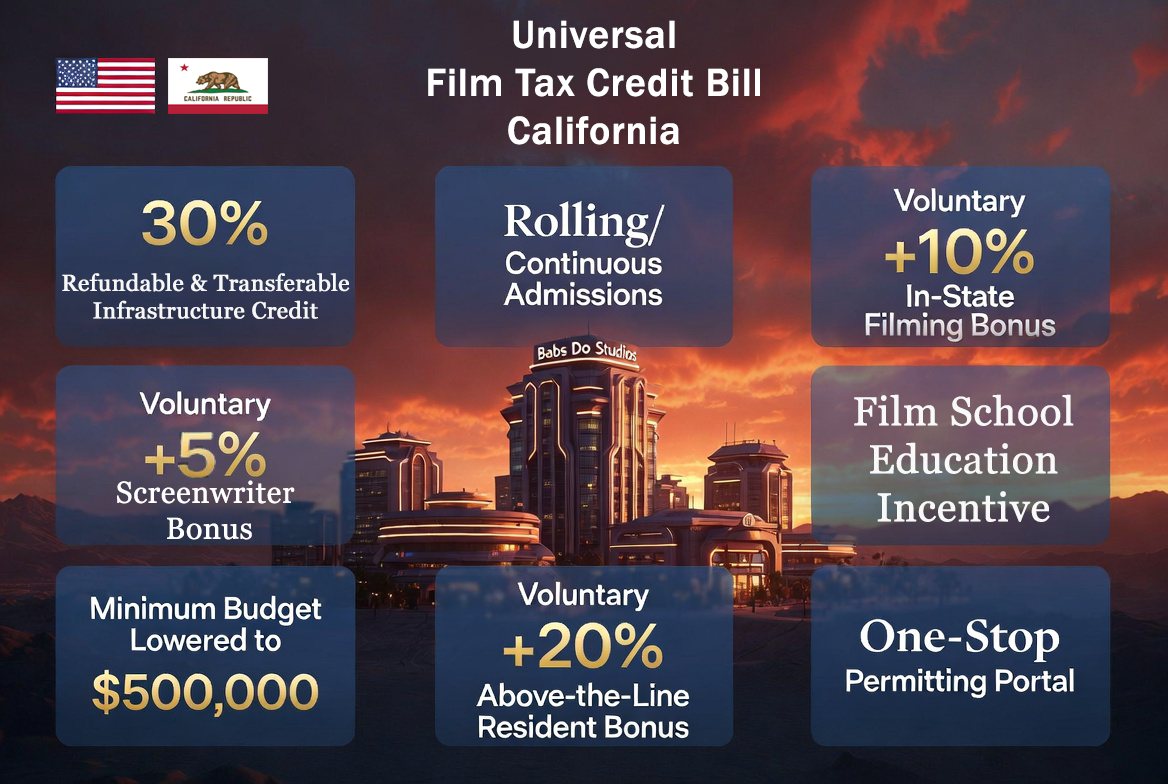
Summary
Our Universal Film Tax Credit Bill for California removes unnecessary barriers, attracts private studio investment, creates more jobs across California, and provides far greater economic impact for the state with greatly increased production, business growth, and new groundbreaking levels of industry development. These amendments are designed to make the program more open, more profitable, and more attractive to both productions and private developers without having to raise the program’s budget. They focus on three goals: (1) spurring new studio construction, (2) increasing program flexibility for filmmakers, and (3) replacing mandates with new positive, voluntary incentives to productively increase diversity, job creation, and benefits for education in Film & Media.
Key Proposed Amendments
1. New 30% Refundable & Transferable Infrastructure Credit
Creates a direct tax credit for capital expenditures on new or expanded studios, sound stages, post-production facilities, theaters, film festivals, and any other potential Film & Media infrastructure. Stackable with the existing production and certified studio credits. Includes a dedicated California Film Infrastructure Development Fund for grants and matching funds. This will drive private investment in the physical capacity California needs and the fund will reduce the burden on taxpayers.
2. Rolling / Continuous Admissions
Replaces fixed application windows with year-round rolling submissions. The California Film Commission would review complete applications and issue allocation letters within 45 days on a first-come, first-served or jobs-ratio basis. This eliminates timing bottlenecks and gives producers certainty.
3. 75% In-State Filming Requirement → Voluntary +10% Bonus
Removes the current hard 75% principal photography (or budget) gatekeeper. Replaces it with a voluntary +10% credit bonus for productions that meet the 75% threshold. Projects that cannot hit 75% still qualify for the base credit, making California more competitive with Georgia, New York, and other states.
4. DEI Workplan & Penalty → Voluntary +4% Talent Bonus
Fully repeals all mandatory diversity workplans, assessments, demographic reporting, and the associated 4% credit penalty. Replaces them with a voluntary +4% credit bonus for productions that pay at least 20% of qualified wages to graduates of any accredited U.S. film, television, digital media, or entertainment program. This shifts from paperwork mandates to a positive incentive for exploring advanced education in Film & Media and hiring emerging talent who are both educated and trained for working in Hollywood.
5. Lowered Minimum Budget Threshold to $500,000
Reduces the minimum production budget required to qualify as a “qualified motion picture” from $1,000,000 to $500,000 across all categories. This opens the program to more independent films, micro-budget projects, student/alumni productions, and emerging creators to foster increased production and even greater economic impact for the state.
6. Voluntary Above-the-Line Resident Bonus
Adds an optional +20% credit on qualified above-the-line wages (writers, directors, producers, principal cast, and key creative personnel) paid to California residents. This rewards hiring local Hollywood talent without creating new mandates.
7. One-Stop Permitting Portal
Requires the California Film Commission to create a true one-stop permitting portal with pre-approved templates for local jurisdictions, reducing bureaucracy and speeding up production approvals.
8. Screenwriter Bonus
Adds a voluntary 5% credit if the production is based on a screenplay or teleplay written by a California resident. This rewards hiring local writers in order to not only bolster Hollywood studio writing but to also help bring up new independent writing talent from within California’s talent pool.
Bill Text
Universal Film Tax Credit Bill for California – 2026
UNOFFICIAL COPY
An act to add Sections 17053.98.2 and 23698.2 to, and to amend Section 17053.98 of, the Revenue and Taxation Code, relating to taxation, and declaring the urgency thereof, to take effect immediately.
Be it enacted by the General Assembly of the State of California:
SECTION 1. Section 17053.98 of the Revenue and Taxation Code is amended to read:
17053.98.
(a) (1)–(4) [Existing base credit percentages and mechanics from AB 1138 remain unchanged.]
(5) Voluntary In-State Filming Bonus. In addition to the base credit percentage allowed under paragraph (4), a qualified motion picture shall receive an additional ten percent (10%) credit on all qualified expenditures if at least seventy-five percent (75%) of principal photography days occur wholly in California or at least seventy-five percent (75%) of the total production budget is incurred for services performed in California and for the purchase or rental of property used in California. This bonus shall be voluntary and shall not be a condition of receiving the base credit.
(6) Voluntary California Film & Media Talent Bonus. In addition to the base credit percentage and any other bonuses allowed under this section, a qualified motion picture shall receive an additional four percent (4%) credit on all qualified expenditures if the qualified taxpayer demonstrates that at least twenty percent (20%) of the total qualified wages paid during the production period were paid to qualified individuals who are graduates of any accredited film, television, digital media, or related entertainment program in the United States. This bonus shall be voluntary and shall not be a condition of receiving the base credit.
(7) Voluntary Above-the-Line Resident Bonus. In addition to the base credit percentage and any other bonuses allowed under this section, a qualified motion picture shall receive an additional twenty percent (20%) credit on qualified above-the-line wages paid to California residents. For purposes of this paragraph, “above-the-line wages” means wages paid to writers, directors, producers, principal cast, and other key creative personnel as defined by regulation of the California Film Commission. This bonus shall be voluntary and shall not be a condition of receiving the base credit.
(8) Voluntary California Screenplay Bonus. In addition to the base credit percentage and any other bonuses allowed under this section, a qualified motion picture shall receive an additional five percent (5%) credit on all qualified expenditures if the production is based on a screenplay or teleplay written by a California resident, as certified by the California Film Commission before principal photography begins. This bonus shall be voluntary and shall not be a condition of receiving the base credit.
(b) (18) “Qualified motion picture” means a motion picture that is produced for distribution to the general public, regardless of medium, that is one of the following and that has a minimum production budget of five hundred thousand dollars ($500,000): (i) A feature. (ii) A miniseries consisting of two or more episodes… (iii) A new television series… (iv) An independent film. (v) A television series that relocated to California. [All other categories and conditions in subdivision (b) remain as in current law, except the previous $1,000,000 minimum is replaced everywhere with $500,000.]
(g) (1) The California Film Commission shall accept applications on a continuous rolling basis throughout the fiscal year. Applications shall be reviewed and ranked on a first-come, first-served basis or using the jobs-ratio formula, with credit allocation letters issued within forty-five (45) days of a complete application.
[All prior references to mandatory diversity workplans, final diversity assessments, demographic reporting requirements, and any associated credit reductions or penalties are repealed and shall have no force or effect.]
SECTION 2. Section 17053.98.2 is added to the Revenue and Taxation Code, to read:
17053.98.2. (a) For taxable years beginning on or after January 1, 2026, there shall be allowed to a qualified infrastructure taxpayer a credit against the “net tax,” as defined in Section 17039, in an amount equal to thirty percent (30%) of qualifying infrastructure expenditures for the development, construction, expansion, or substantial rehabilitation of qualified film and television production infrastructure in California.
(b) For purposes of this section:
(1) “Qualifying infrastructure expenditure” means capital costs incurred in California for the acquisition, construction, or substantial rehabilitation of a qualified studio facility, sound stage, post-production facility, virtual-production stage, or related workforce-training facility, as defined by regulation of the California Film Commission. (2) “Qualified infrastructure taxpayer” means any taxpayer, including a single-member limited liability company disregarded for tax purposes, that executes an infrastructure tax incentive agreement with the California Film Commission and incurs qualifying infrastructure expenditures.
(c) The credit shall be refundable and fully transferable. A qualified infrastructure taxpayer may sell or assign any portion of the credit to an unrelated party.
(d) Credits issued under this section shall not count against the annual cap established under Section 17053.98. This credit may be claimed in addition to any credit allowed under Sections 17053.98 or 17053.98.1.
SECTION 3. Section 23698.2 is added to the Revenue and Taxation Code, to read:
23698.2. (a) For taxable years beginning on or after January 1, 2026, there shall be allowed to a qualified infrastructure taxpayer a credit against the tax imposed by this part in an amount equal to thirty percent (30%) of qualifying infrastructure expenditures, on the same terms and conditions as the personal income tax credit allowed under Section 17053.98.2.
SECTION 4. A new section is added to the Revenue and Taxation Code, to read:
23696. (a) There is hereby created in the State Treasury the California Film Infrastructure Development Fund. (b) The fund shall consist of appropriations, application fees collected under the film tax credit program, private donations, and federal grants. (c) Moneys in the fund shall be used exclusively by the California Film Commission for grants, loans, or matching funds to support studio and production infrastructure projects.
SECTION 5. The California Film Commission shall develop and maintain a one-stop permitting portal with pre-approved templates to streamline local jurisdiction approvals for qualified productions and infrastructure projects.
SECTION 6. This act is an urgency statute necessary for the immediate preservation of the public peace, health, or safety within the meaning of Article IV of the Constitution and shall go into immediate effect.